Page updated · Independent public directory · Last reviewed November 16, 2026 · Not a government agency · By Bill Dahlstrom
Free Water Treatment Plan From Your Test Results
Add each test from your lab report and how many people live in your home. You see which results are over EPA's limit first, then what fixes each one and what size to get. Below the tool are three options for each problem: what each one fixes, what it doesn't, and a price range when the source gives one.
Your lab report
Type your numbers, or let us read them from your report. Either way, you check every number before you see a result.
This page reads a PDF from your lab right here in your browser, and nothing leaves your device. A photo, or a scanned page with no words you can select, goes to an automated reader on our server. It sends back the numbers and does not keep the picture or anything it read. You can cover your name and address before you take the photo. Before a photo goes, this page strips its hidden details, like where it was taken.
Numbers we read
We read these numbers. Check each one against your report. Fix anything that is off, and remove any line that is not one of your results. ND means not detected.
Test
Result
Unit
On your report
Remove
Lines we could not match
These lines look like results, but they are not on our list of tests, or we could not tell which test they are. Check them against your report. If one is a test we list, add it above.
Your results
EPA limit for public water systems, shown for reference. Private wells are not regulated.
To save a PDF, pick "Save as PDF" in the print window. The link keeps your numbers after the # sign, so it opens these results again on any device you send it to.
Treatment options
Each problem has three options: a good one, a better one, and a whole-house one. Where the sources name no option for a step, it says so.
Hardness
Hard water is about scale, spotting, soap, and appliances. A water softener fixes it, and treating it is your choice.
"water softening simply removes hardness minerals and eliminates problems that are a nuisance and not a threat to human health." Penn State Extension
"levels below 7.0 gpg will probably not cause major scaling and soap film" Penn State Extension
Good: Softener on the hot water only
Fixes
Scale in the water heater and on hot water fixtures.
Does not
Soften cold water at any tap.
Price
About $500 to $1,500 for the softener itself, before installation (Penn State Extension)
"In some cases, you may desire to soften the hot water only." Penn State Extension
"scales can also build up on hot water heaters and decrease their useful life." Penn State Extension
Better: Demand-control softener with toilets and outdoor faucets left off
Fixes
Scale, spots, and soap film at showers, sinks, and the laundry.
Does not
Soften toilets, outdoor faucets, or a basement sink, which do not need it.
Price
About $500 to $1,500 for the softener itself, before installation (Penn State Extension)
"Showers, sinks, and laundry hookups probably should be softened; toilets, outside spigots, and basement sinks can be bypassed." Penn State Extension
"Demand-control models, with either electrical and mechanical sensors, usually regenerate after so many gallons of water have been softened." Penn State Extension
"will waste more water and salt because they regenerate whether the resin needs it or not." Penn State Extension
Whole-house: Softener on all incoming water
Fixes
Hardness at every tap.
Does not
Pay off unless the water is very hard, since most fixtures can skip it.
Price
About $500 to $1,500 for the softener itself, before installation (Penn State Extension)
"unless your water is extremely hard, all the incoming water does not need to be softened." Penn State Extension
"water softeners will not necessarily remove any of the more serious drinking water contamination problems." Penn State Extension
"The exchange of hardness minerals for sodium adds 7.5 milligrams per quart for each gpg of hardness removed." Penn State Extension
"Estimates indicate that about 50 gallons of water are used for each regeneration cycle." Penn State Extension
Iron and manganese
Iron and manganese stain sinks and laundry and leave a metallic taste. Treat them where the water enters the house. The right system depends on how much is in the water.
"Since iron and manganese are aesthetic problems that affect all potential uses of the water, they must be removed from all water entering the home using Point-of-Entry (POE) treatment devices." Penn State Extension
"it is also important to determine the form of the iron and manganese." Penn State Extension
Good: Water softener
Fixes
Dissolved iron under 5 mg/L, along with hardness.
Does not
Handle iron that is already rust colored when it comes out of the tap. That clogs the softener.
"Softeners are generally only recommended when the water pH is greater than 6.7, the water hardness is between 3 and 20 grains per gallon (50- 350 mg/L) and the dissolved iron concentration is less than 5 mg/L." Penn State Extension
"Oxidized forms of iron and manganese will foul the softener resin." Penn State Extension
Better: Oxidizing filter
Fixes
Dissolved or rust colored iron and manganese, about 3 to 10 mg/L combined.
Does not
Run without upkeep. It needs regular backwashing, and greensand filters need refills of a chemical that must be handled with care.
"They are generally recommended when the combined iron and manganese concentration is in the range of 3 to 10 mg/L." Penn State Extension
"Manganese greensand filters require significant maintenance including frequent regeneration with a potassium permanganate solution as it is consumed during oxidation of the dissolved metals." Penn State Extension
Whole-house: Chlorine feed followed by a filter
Fixes
Iron and manganese over 10 mg/L combined.
Does not
Run without upkeep. Its chlorine tank needs refills, its filter needs backwashing, and a carbon filter may be needed for the chlorine taste.
"When combined levels of iron and manganese exceed 10 mg/L, the most effective treatment involves oxidation followed by filtration." Penn State Extension
"Significant system maintenance is required with these units." Penn State Extension
"make sure you shop around and compare treatment units and prices among several reputable dealers" Penn State Extension
Bacteria
Confirm the result, find how bacteria are getting in, and fix that first. Treat all the water only if they come back.
"Before making any costly decisions about your water supply, make sure the coliform bacteria result you have received is accurate." Penn State Extension
Good: Retest and a sanitary well cap
For a private well
Fixes
Bacteria getting in at the top of the well.
Does not
Clear bacteria already in the well.
"make sure the top of the casing has a tight, sanitary well cap that prevents insects and surface water from entering." Penn State Extension
"If E. coli bacteria are present, check your septic system for proper functioning and remove or divert obvious sources of animal waste from around the well or spring." Penn State Extension
Better: Shock chlorination by a well professional
For a private well
Fixes
A one-time event, like a new pump or a heavy rain.
Does not
Keep bacteria out if they keep getting in. Retest to find out.
"It is recommended to have shock chlorination done by a well professional." Penn State Extension
"Retest the water for coliform bacteria within 10 to 14 days and again several months later." Penn State Extension
"This procedure was most successful in wells that had small numbers of coliform bacteria (fewer than 10 colonies per 100 mL) and no E. coli bacteria." Penn State Extension
Whole-house: Ultraviolet light or a chlorinator
For a private well
Fixes
Bacteria that come back after shock chlorination, in all the water entering the house.
Does not
Work on cloudy water without a sediment filter ahead of it. UV also leaves no chlorine behind in the pipes.
"you'll need to consider buying a disinfection treatment system that continuously treats all of the water entering the home." Penn State Extension
"UV light units are not recommended for water supplies where total coliform bacteria exceed 1,000 colonies per 100 mL or fecal coliform bacteria exceed 100 colonies per 100 mL." Penn State Extension
"the light bulb will slowly lose intensity over time and will require replacement about once a year." Penn State Extension
Nitrate
Treat the water you drink and cook with, and look for where the nitrate comes from.
"While treatment to meet drinking water needs is practical, treatment of larger quantities, like livestock supplies, is costly." Penn State Extension
"Note that boiling water does not remove nitrates and is not a treatment alternative." Penn State Extension
Good: Bottled water for drinking and cooking
Fixes
Nitrate in what you drink and cook with.
Does not
Change the water at the tap.
"To solve the nitrate problem, you can substitute bottled water for drinking and cooking water, eliminate the nitrate source, use an alternate water supply, or treat the water before using it." Penn State Extension
Better: Reverse osmosis or a distiller at the kitchen tap
Fixes
Most of the nitrate at that one tap.
Does not
Treat other taps. Very high nitrate may still be over the limit after reverse osmosis, so retest.
Price
Distiller running cost: about 30 cents a gallon in energy (Penn State Extension)
Where
Drinking and cooking water only, at one tap.
"Ion exchange units, reverse osmosis, or distillation all remove nitrate from drinking water." Penn State Extension
"Estimates are around 83 to 92 percent of the incoming nitrate." Penn State Extension
"Unfortunately, remaining nitrate-nitrogen may still result in drinking water that exceeds the standards of 10 mg/l nitrate-nitrogen." Penn State Extension
"A typical home unit produces about a gallon of water every four to five hours." Penn State Extension
Whole-house: Fixing the source, or a nitrate ion exchange unit
For a private well
Fixes
Nitrate reaching the well, when the source is a septic system or surface water near the well.
Does not
Help when the nitrate comes from farm fields you do not control. Ion exchange also struggles with high sulfate and can make water corrosive.
"In the long term, preventing nitrate contamination at the source is more effective than treating it." Penn State Extension
"Also ensure that the well casing extends at least a foot above ground and has a suitable cap." Penn State Extension
"An ion exchange unit operates much like a household water softener." Penn State Extension
"Since the backwash brine will be high in nitrates, care must be given to its disposal." Penn State Extension
Lead
Filter the water you drink and cook with through a filter certified for lead, then find where the lead comes from.
"If your first-draw water test result contains detectable lead or if you identified multiple sources of lead in your plumbing, you should take corrective action." Penn State Extension
"However, flushing alone is not a reliable form of lead control." Penn State Extension
Good: Pitcher or faucet filter certified for lead
Fixes
Lead in the water you pour through it.
Does not
Work past its cartridge life. Change the cartridge on time.
"If you are selecting a device to remove lead, the package needs to state that it meets NSF/ANSI 53 or 58 for the reduction of lead." Penn State Extension
"This tool will help consumers select point-of-use (POU) and pitcher filters that have been evaluated by an accredited third-party certification body for drinking water lead (Pb) reduction to 5 parts per billion (ppb) or less and particulate reduction (Class I) capabilities against both NSF/ANSI Standards 53 and 42." EPA
Better: Reverse osmosis or activated alumina at the kitchen tap
Fixes
Lead at that one tap, with no pitcher to refill.
Does not
Treat other taps, and it makes only a few gallons a day.
"The most permanent lead prevention method is to replace the leaded components in the plumbing system with newer, non-leaded components." Penn State Extension
"If the lead originates from lead service lines within a public water system, this method should be coupled with lead service line replacement and/or point of use filters." Penn State Extension
"Acid-neutralizing filters can be installed to reduce water corrosivity by adding calcium and by increasing the pH of the water." Penn State Extension
Arsenic
Treat the water you drink and cook with, then retest to make sure the system is working.
"Common treatment methods used to remove arsenic from well water include reverse osmosis (RO), adsorption columns, ion exchange, and distillation." Texas A&M AgriLife Extension
"After well owners install a treatment system, they should test their water periodically to ensure that arsenic is being removed." Texas A&M AgriLife Extension
Good: Adsorption cartridge under the sink
Fixes
Arsenic at one tap, with simple upkeep.
Does not
Last forever. Cartridges wear out, and a metered cartridge shuts off when it is used up.
"Modified activated alumina and iron-based sorbents are among the adsorptive materials that can be used to remove arsenic from water" Texas A&M AgriLife Extension
"well owners can use metered cartridges that will shut off the system outlet once a designated volume of water has passed through the treatment unit." Texas A&M AgriLife Extension
Better: Reverse osmosis at the kitchen tap
Fixes
Most arsenic at that one tap, along with dissolved solids and sulfate.
Does not
Treat other taps. Most of the water it takes in goes down the drain.
"New membranes cost about $150, and a carbon-based pre-filter typically costs between $15 and $50." Texas A&M AgriLife Extension
Whole-house: Whole-house system
Texas A&M's guide names no whole-house system for arsenic. Its other two options are ion exchange, about $400 to $1,500, and a distiller, about $300 to $1,200.
"Wastes about one gallon of water per every gallon treated." EPA
"Requires changing filter cartridges and the RO membrane." EPA
Whole-house: Whole-house system
EPA's filter page covers filters at one tap. For more, EPA says to ask your state and your water utility.
"Contact your state environmental protection agency or health department and your local water utility to find out what actions they recommend." EPA
"the current certification standards for PFAS filters (as of April 2024) do not yet indicate that a filter will remove PFAS down to the levels EPA has now set for a drinking water standard." EPA
Fluoride
Treat the water you drink and cook with, using a reverse osmosis system whose label lists fluoride.
"These filters may also reduce arsenic, fluoride, radium, sulfate, calcium, magnesium, potassium, nitrate, and phosphorous." CDC
"Check the filter's label for the specific chemicals it can remove." CDC
Good: Reverse osmosis certified for fluoride
Fixes
Fluoride at the kitchen tap.
Does not
Treat other taps.
Where
Drinking and cooking water only, at one tap.
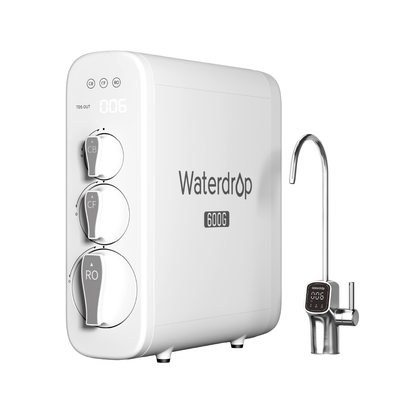
Waterdrop G3P600, under-sink reverse osmosis. It is certified for fluoride under NSF/ANSI 58 (IAPMO R&T listing WC-13976, checked November 14, 2026). The small commission from purchases made through this link helps keep this free public directory open, at no extra cost to you.Shop Waterdrop G3P600 (affiliate link).
"These filters may also reduce arsenic, fluoride, radium, sulfate, calcium, magnesium, potassium, nitrate, and phosphorous." CDC
Better: Other home filters
CDC's filter page names reverse osmosis for fluoride and no other home filter.
Whole-house: Whole-house system
CDC's filter page covers filters at the tap, not whole-house systems.
Pages read October 24, 2026. Quotes are word for word. A price shows only where the source gives one. This plan is general guidance from these sources, not a test of your water or an inspection of your home.
By Bill Dahlstrom, 15 years in radon mitigation. His company has more than 700 five-star Google reviews. Health facts on this page come from the agencies linked here. About Bill. His water story