
Pennsylvania Water Testing: Low-Cost Well and Tap Tests
City of Bethlehem Water & Sewer Resources Department / Bethlehem Water Lab offers water testing in Pennsylvania, but only to people who qualify.
Customers whose home or business meets the criteria for the City's lead and copper compliance sampling pool; sampling occurs about every three years, with the next round in 2028.

By Bill Dahlstrom. About Bill. His water story
Key facts
- Drop-off spots:
- 4
Test options
- public tests: 6plus 1 paused
- free test: 1
- certified-lab list: 1
Programs in Pennsylvania
Penn State Agricultural Analytical Services Laboratory Drinking Water Testing
$60, other prices posted
- Bacteria
- E. coli
- pH
- Total dissolved solids
- Hardness
- Alkalinity
- Corrosivity index
- Copper
- Iron
- Manganese
- Lead
- Nitrate
- Aluminum
- Sulfate
- Barium
- Chloride
- Arsenic
- Cadmium
- Chromium
- Nickel
- Zinc
- Fluoride
- Sodium
- Total suspended solids
How to get it and who can use it
Obtain a Drinking Water Test Kit from a Penn State county extension office, collect the sample following the included instructions, then mail the kit overnight to the lab along with payment.
Who can use it. Statewide Pennsylvania; over 1 million private wells serving 3.5 million people in rural areas
All posted prices. WD01 Standard package (total coliform bacteria, E. coli, pH, total dissolved solids) is $60.00; packages go up to WD08 Extensive at $220.00; individual analyses are $15.00 to $45.00 each
- Hours
- Office hours Monday-Friday, 8:00 AM - 4:00 PM
- Sample drop-off
- The lab cannot accept any water samples for bacteria on a Friday
- Bottles
- Test kits available at many county extension offices
- How to get it
- If you need the bacteria test only, contact the laboratory to receive a smaller cooler test kit
- Collecting the sample
- After taking your water sample, send the kit to the laboratory by overnight mail with payment; for bacteria test, lab must receive sample within 30 hours after sampling
- Results
- Tests are complete within 10-14 business days after sample receipt by the laboratory
- Bring
- The kit consists of a cooler, shipping box, sample bottles, instructions on how to take a sample, and a submission form
- Agricultural Analytical Services Laboratory, 720 Tower Rd, University Park. 814-863-0841
Checked October 1, 2026.
High results
Call your local health department first and ask what to do next.
For bacteria, shock chlorination or ultraviolet light comes before a filter.
Reverse osmosis treats nitrate in the water you drink and cook with.
A water softener treats hardness. EPA sets no drinking water limit for hardness.
Penn State Extension says "water softening simply removes hardness minerals and eliminates problems that are a nuisance and not a threat to human health."
For lead, choose a filter certified to NSF/ANSI 53 or 58 for lead.
Reverse osmosis treats arsenic at the kitchen tap.
Kirby Memorial Health Center Environmental Laboratory Drinking Water Testing
Price not posted
- Bacteria
- E. coli
- Metals
How to get it and who can use it
Contact the lab at (570) 823-5450 ext. 353 to request testing capabilities, sample containers, sample pick-up/collection, and a quotation for analysis.
Who can use it. Private individuals as well as local, state, and federal agencies, engineering and environmental consulting firms
- Hours
- Sample receiving/bottle pick up: Monday-Thursday 8:30 am to 2:00 pm, Friday 8:30 am to 11:00 am
- Bottles
- Laboratory provides a sample pick-up and/or collection service; contact for sample containers
- How to get it
- Contact the laboratory to request information on testing capabilities, sample containers, sample pick-up/collection, and quotations for analysis
- Kirby Memorial Health Center Environmental Laboratory, 71 N. Franklin Street, Wilkes-Barre. Sample receiving/bottle pick up: Monday-Thursday 8:30 am to 2:00 pm, Friday 8:30 am to 11:00 am. (570) 823-5450 Ext. 353
Checked October 2, 2026.
City of Bethlehem Water & Sewer Resources Free Lead and Copper Sampling
Limited
- Lead
- Copper
How to get it and who can use it
Report your water service line material through the City's Service Line Identification Survey; if your home or business meets the criteria for lead and copper sampling, a Water Lab employee will drop off instructions and bottles to fill and pick up the filled bottles the next morning.
Who can use it. Customers whose home or business meets the criteria for the City's lead and copper compliance sampling pool; sampling occurs about every three years, with the next round in 2028
- How to get it
- Once you have identified your service line material, report your findings using the survey link on this page, or using the form on the City of Bethlehem’s Service Line Inventory map.
- Collecting the sample
- A Water Lab employee will pick up the filled bottles the next morning.
- Free or reduced cost
- Lead and copper sampling is free of charge and involves a Water Lab employee dropping off instructions and bottles for you to fill.
Checked from an archived copy dated 2026.
- City of Bethlehem, Water & Sewer Resources, 10 East Church Street, Bethlehem. 610-865-7000
Checked October 2, 2026. Official page
Free Lead and Copper Tap Water Test
Free
- Lead
- Copper
How to get it and who can use it
Fill out the online request form to have PWD mail you a kit to test your tap water for lead and copper.
Who can use it. Available to PWD customers at homes only; not available for schools, daycares, or childcare centers.
- Bottles
- A testing kit with two bottles is mailed to the customer
- How to get it
- Fill out the request form online to receive a testing kit
- Collecting the sample
- Fill bottles after a stagnation period of at least 6 hours of no water use, typically first thing in the morning, with cold water from the kitchen sink faucet, then call for pickup
- Results
- PWD will let the customer know what they find and if there are any actions to take
- Free or reduced cost
- No cost to customers for lead and copper tests
- Philadelphia Water Department, Philadelphia. 215-685-6300
Checked October 1, 2026. Official page
Pittsburgh Water Lead Test Kit
Price not posted
- Lead
How to get it and who can use it
Request a lead test kit with the online form, by emailing LeadHelp@pgh2o.com, or calling 412-255-8987. Pittsburgh Water mails a kit with prepaid return shipping. The request page does not state a test fee.
Who can use it. Kits are only for Pittsburgh Water customers.
- Hours
- Monday through Friday, 8 a.m. to 5 p.m.
- Bottles
- Kit is mailed; allow 10-14 business days from request for the kit to arrive
- How to get it
- Fill out the form or contact the Lead Help Desk by email or phone with name, mailing address, and phone number
- Results
- Results take approximately 4-6 weeks for processing Results shared via mail or email
- Free or reduced cost
- If elevated lead levels are found, a free water filter pitcher certified to remove lead is provided
- Pittsburgh Water and Sewer Authority, Pittsburgh. Monday through Friday, 8 a.m. to 5 p.m.. 412-255-8987
Checked October 6, 2026. Official page
Municipal Authority of Westmoreland County Tap Water Lead Testing
Price not posted
- Lead
How to get it and who can use it
Call the MAWC lead hotline at 724-755-5858 (or main office at 724-755-5800) to discuss lead concerns and testing options with staff; testing at the tap is the only way to measure lead levels in a home or workplace.
Who can use it. MAWC water customers concerned about possible lead exposure at the tap
- How to get it
- Call 724 755-5858 to discuss lead concerns and testing options with MAWC staff
- Municipal Authority of Westmoreland County, Main Office, 124 Park and Pool Rd, New Stanton. 724-755-5800
Checked October 2, 2026.
Penn State Extension Private Water Supply Education and Water Testing
Paused when we checked on October 18, 2026. It is left out of search results. Check the official page before you rely on it.
Paused
- Bacteria
- pH
- Nitrate
- Manganese
- Lead
- Copper
- Barium
- Sodium
- Arsenic
How to get it and who can use it
Register for a free one-hour Penn State Extension class and attend it live. Testing supplies are handed out after the class, and you return the sample in a prepaid mailer by the date given. When we checked, the class page listed no dates and said "Please check back for future occurrences of this event." The Pennsylvania Department of Health takes questions about this free testing at 717-787-3350.
Pennsylvania residents whose primary home (not a camp or summer home) uses a private well, spring, or cistern can use it, after they register for and attend the live one-hour class. Only one test is permitted per household.
Checked October 18, 2026.
To find a certified lab yourself, use Pennsylvania Department of Environmental Protection, Bureau of Laboratories.
Common questions
How many public programs are open in Pennsylvania?
We list 6 open public programs in Pennsylvania, plus 1 that was paused when we checked.
How many free tests are listed in Pennsylvania?
We list 1 free test in Pennsylvania. Check who can use it on its card.
Does Pennsylvania link a certified lab list?
Yes. This page links 1 certified-lab list, so you can find a lab yourself.
For a private well, EPA says: "Test your private well annually for total coliform bacteria, nitrates, total dissolved solids, and pH levels."1
For city water, EPA says of the yearly water quality report: "Reports must be sent by your water supplier each year by July 1."2
Which filter might you need?
Test first, then treat what the test finds. These are problems Pennsylvania well tests often turn up, how common each one was, and what fixes it. Unless a line says otherwise, the numbers come from a Penn State study of 701 private wells sampled across Pennsylvania in 2006 and 2007.
The small commission from purchases made through these links helps keep this free public directory open, at no extra cost to you.
Coliform bacteria
33 percent of wells had coliform bacteria, and 14 percent had E. coli.
What fixes it. Penn State suggests having a well professional shock chlorinate the well, then testing again. If bacteria come back, it says to consider a disinfection system that treats all the water entering the home, such as chlorination or ultraviolet light.
Our pick. None. Bacteria call for disinfecting the well and the whole house supply, and we do not list a disinfection system.
Nitrate
2 percent of wells had nitrate above the 10 mg/L drinking water standard.
What fixes it. Ion exchange, reverse osmosis, or distillation. Boiling does not remove nitrate.
Our pick. None of the filters we link is certified for nitrate. Look for a reverse osmosis unit certified to NSF/ANSI 58 for nitrate, and check the certifier's own listing for that model.
Lead and acidic water
12 percent of wells tested in 2007 had high lead in the first water from the tap, and 18 percent had acidic water, with a pH below 6.5.
What fixes it. An acid-neutralizing filter keeps acidic water from picking up lead in the pipes. Reverse osmosis or activated alumina at the kitchen tap removes lead already in the water.
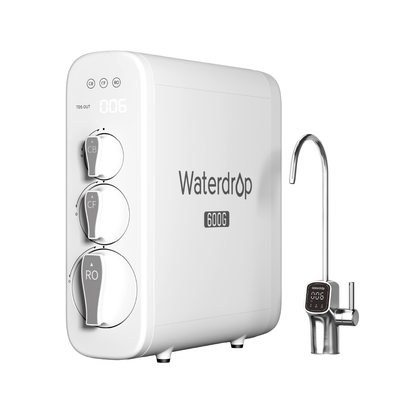
Our pick. Waterdrop G3P600 (affiliate link), under-sink reverse osmosis. It is certified for lead under NSF/ANSI 58 (IAPMO R&T listing WC-13976, checked November 14, 2026).
Arsenic
2 percent of wells were above the 10 µg/L arsenic standard.
What fixes it. Reverse osmosis at one tap, which Penn State says removes more than 95 percent of arsenic under ideal pressure. Activated alumina and ion exchange are other options.
Our pick. Waterdrop G3P600 (affiliate link), under-sink reverse osmosis. Waterdrop says it reduces arsenic, but we found no independent certification for that.
Iron and manganese
A Penn State survey found too much iron in 17 percent of private water supplies (it gives no year). Of 7,691 samples sent to Penn State's lab from 2007 to 2025, 22.3 percent were over EPA's manganese guideline.
What fixes it. A whole-house unit, because Penn State says iron and manganese must come out of all the water entering the home. Oxidizing filters are one option, and a water softener can handle small amounts.
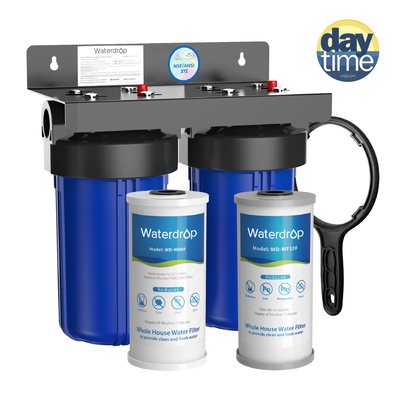
Our pick. Waterdrop WHF21-FG (affiliate link), whole house filter for iron and manganese. Waterdrop says it reduces iron and manganese, but we found no independent certification for that.
Radon in water
Of 1,041 Pennsylvania wells tested from 1986 to 2015, 14 percent had radon above 4,000 pCi/L and 87 percent above 300 pCi/L, two levels EPA has proposed for public water (USGS).
What fixes it. Test the water and the air in your home. USGS says that is the only way to know, and to treat the home if the tests call for it.
Our pick. None. We do not list a radon water treatment system.


Put a number from your report into the results checker, or see which filter fixes what.
Sources: Center for Rural Pennsylvania, Drinking Water Quality in Rural Pennsylvania (2009); Penn State Extension, Coliform Bacteria; Penn State Extension, Nitrates in Drinking Water; Penn State Extension, Lead in Drinking Water; Penn State Extension, Removal of Arsenic from Wells in Pennsylvania; Penn State Extension, Iron and Manganese in Private Water Systems; Penn State Agricultural Analytical Services Laboratory, Pennsylvania drinking water test summary; USGS, Evaluation of Radon in Groundwater and Indoor Air; USGS, High Levels of Radon Found in Some Wells Across Pennsylvania. Checked October 18, 2026.
Counties with a local water test
Pennsylvania has a local water test in 5 counties.
Pennsylvania has 62 counties with no local test we verified.
Source: Programs on this page
Data table
| Counties with a verified local test | 5 |
|---|---|
| Open when checked | 5 |
| Paused when we checked | 0 |
| Counties with no local test | 62 |
| Counties in the state | 67 |
5 counties with a local test
- Allegheny CountyPittsburgh Water Lead Test Kit
- Luzerne CountyKirby Memorial Health Center Environmental Laboratory Drinking Water Testing
- Northampton CountyCity of Bethlehem Water & Sewer Resources Free Lead and Copper Sampling
- Philadelphia CountyFree Lead and Copper Tap Water Test
- Westmoreland CountyMunicipal Authority of Westmoreland County Tap Water Lead Testing
More help in Pennsylvania
- Free lead testing. Pennsylvania DEP No-Cost Water Sampling Program for Schools and Childcare Facilities
- Lead poisoning prevention. Pennsylvania Lead Poisoning Prevention (PA Department of Health)
- Lead paint repair help. Reading, Lead Hazard Control Program (LHCP)
- Lead paint repair help. Philadelphia, Lead and Healthy Homes Program
- Drinking water program. Pennsylvania DEP Lead and Copper Rule / Service Line Notifications
- Well owner help. Penn State Extension, Master Well Owner Network
- Understand your results. Penn State Extension, How to Interpret a Water Analysis Report
- Repair help. PENNVEST, Homeowner Sewage ProgramLow-interest loans of $2,500 to $25,000 to repair or replace a septic system or sewer line, or to connect to public sewer, at your main home. Apply through a participating lender.
- PFAS. Pennsylvania DEP, PFAS in Pennsylvania
- Radon. Pennsylvania radon test kits (sister site)
Links checked between October 2, 2026 and October 4, 2026.
When your results come back, our guide explains what your results mean.
Sources
Checked October 4, 2026.
8 program pages
- Penn State Agricultural Analytical Services Laboratory (AASL), Drinking Water Testing - Agricultural Analytical Services Laboratory - Penn State College of Agricultural Sciences. Checked October 1, 2026.
- Pennsylvania Department of Environmental Protection, Bureau of Laboratories, . Checked October 2, 2026.
- Angeline Elizabeth Kirby Memorial Health Center, Environmental Laboratory, Kirby Memorial Health Center: Environmental Laboratory. Checked October 2, 2026.
- City of Bethlehem Water & Sewer Resources Department / Bethlehem Water Lab, City of Bethlehem: Customer Service Line Identification Survey. Checked October 2, 2026.
- Philadelphia Water Department, Request Water Testing, Philadelphia Water Department. Checked October 1, 2026.
- Pittsburgh Water and Sewer Authority (PWSA), Lead Test Kit Request, Pittsburgh Water and Sewer Authority. Checked October 6, 2026.
- Municipal Authority of Westmoreland County (MAWC), Municipal Authority of Westmoreland County: Facts About Lead. Checked October 2, 2026.
- Penn State Extension, with the Pennsylvania Department of Health, Private Water Supply Education and Water Testing, Penn State Extension. Checked October 18, 2026.